Turn Eval Results Into a Better Model
This note covers Will Brown and Florian Brand’s session in the AI Product Engineering series.
Will and Florian from Prime Intellect caution that fine-tuning should be the last approach for improving an eval score, because you can often improve a score without changing the model. They recommend working through the following items first:
- Read the traces to understand what is failing.
- Fix the eval and the environment.
- Improve retrieval, context, and the harness.
The second item might seem surprising, but small issues in the eval itself can be material. They show an example where multiplying task timeouts by 5 on Terminal-Bench 2 improved the score from 46.3% to 60.97%.
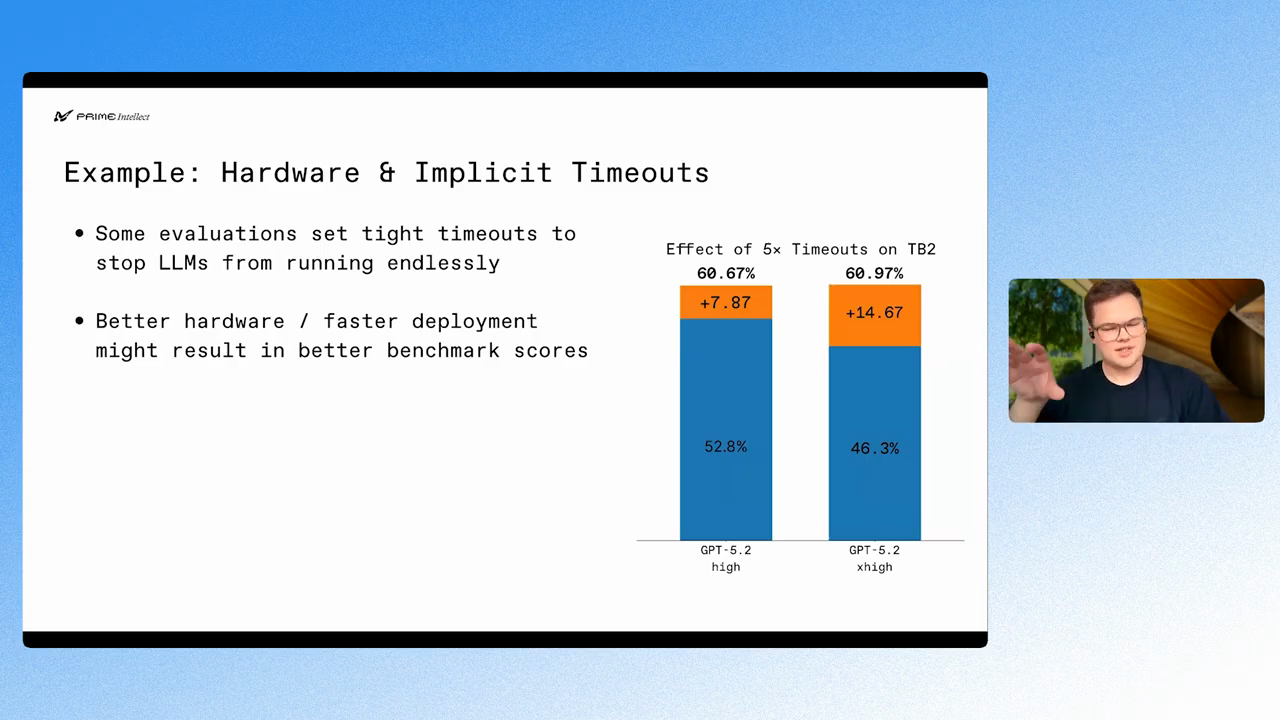
They also shared common footguns toavoid when setting up eval infrastructure:
- Beware of forcing temperature to 0 when the model was trained to sample at 1. This might affect reproducibility on benchmarks.
- Look for max token limits or turn caps that cut off reasoning early.
- Provision enough CPU and memory for the agent sandbox.
- Swap a bloated harness for a minimal one and let the model run bash instead of bespoke tools.
- Add task-specific skills to the context before you conclude the model can’t do the task.
Only explore post-training when two things are true: a correct answer can be verified automatically, and the model scores above 0 and below 100 on your eval.
To try it, Prime Intellect’s verifiers library defines the task and reward in Python, and their hosted RL runs the training from a short config file. Ready-made environments are available to start from.
Watch Will and Florian’s full session on post-training.
Post-training needs an eval that rewards the right behavior, because RL exploits anything less. If you want to build evals like that with a live group, the AI Evals course has hands-on exercises and office hours.