Q: How do I know if I can trust my automated eval?
For an evaluator that makes judgments, test it against human-labeled examples of the failure you want to detect. This applies to LLM judges and other machine learning classifiers. You need to know how often they catch failures and how often they raise false alarms. If code can directly check the condition, you do not need human labels for that check. See which model or method to use for an eval.
Start by splitting your labeled examples into three separate sets:
- Training set: Use these examples to teach the evaluator what to look for. For an LLM judge or zero-shot classifier like Jev, you can include them in its prompt.
- Development set (dev): Run the evaluator on these examples and compare its decisions with your labels. Inspect disagreements to improve the prompt or choose between models. Repeat this as you develop the evaluator. A prompt tuning algorithm will use the dev set to guide its changes.
- Test set: Set these examples aside until you finish making changes. Use them for a final check on examples that have not influenced any decisions about the evaluator.
Each time you use dev results to change the prompt or choose a model, information from those examples influences the evaluator. After many rounds, it may do well on the dev set but poorly on new examples. This is overfitting, and it can happen even if you never put the dev examples directly in the prompt. The test set gives you a final check on data that hasn’t guided those changes.
If test scores are much worse than dev scores, investigate whether you’ve overfit. Small samples make these measurements less certain, and differences between the sets can also cause a gap. If you’ve overfit, revisit the instructions and examples, then repeat development with a new, untouched test set reserved for the final check. Addressing overfitting is beyond the scope of this FAQ.
To measure how well the evaluator aligns with human judgments, use the following metrics. Here, “positive” means an error is present, matching the flashcard below.
- True positive rate (TPR), also called recall, measures how many actual failures the evaluator catches. If people identify 10 failures and the evaluator catches eight, its TPR is 80%. Prioritize this when missing a failure is costly.
- True negative rate (TNR) measures how many good outputs the evaluator correctly passes. If people identify 100 good outputs and the evaluator passes 95, its TNR is 95%. The other five are false alarms. A high TNR helps avoid wasting people’s time reviewing good outputs that were incorrectly flagged.
Track both rates as you make changes. Catching more failures can come at the cost of more false alarms. Choose acceptable levels based on the consequences for your application. If failures are rare, even a small false-alarm rate can create a lot of unnecessary reviews.
The flashcard below illustrates this process for an LLM judge. The same separation of development and testing applies to other evaluators.
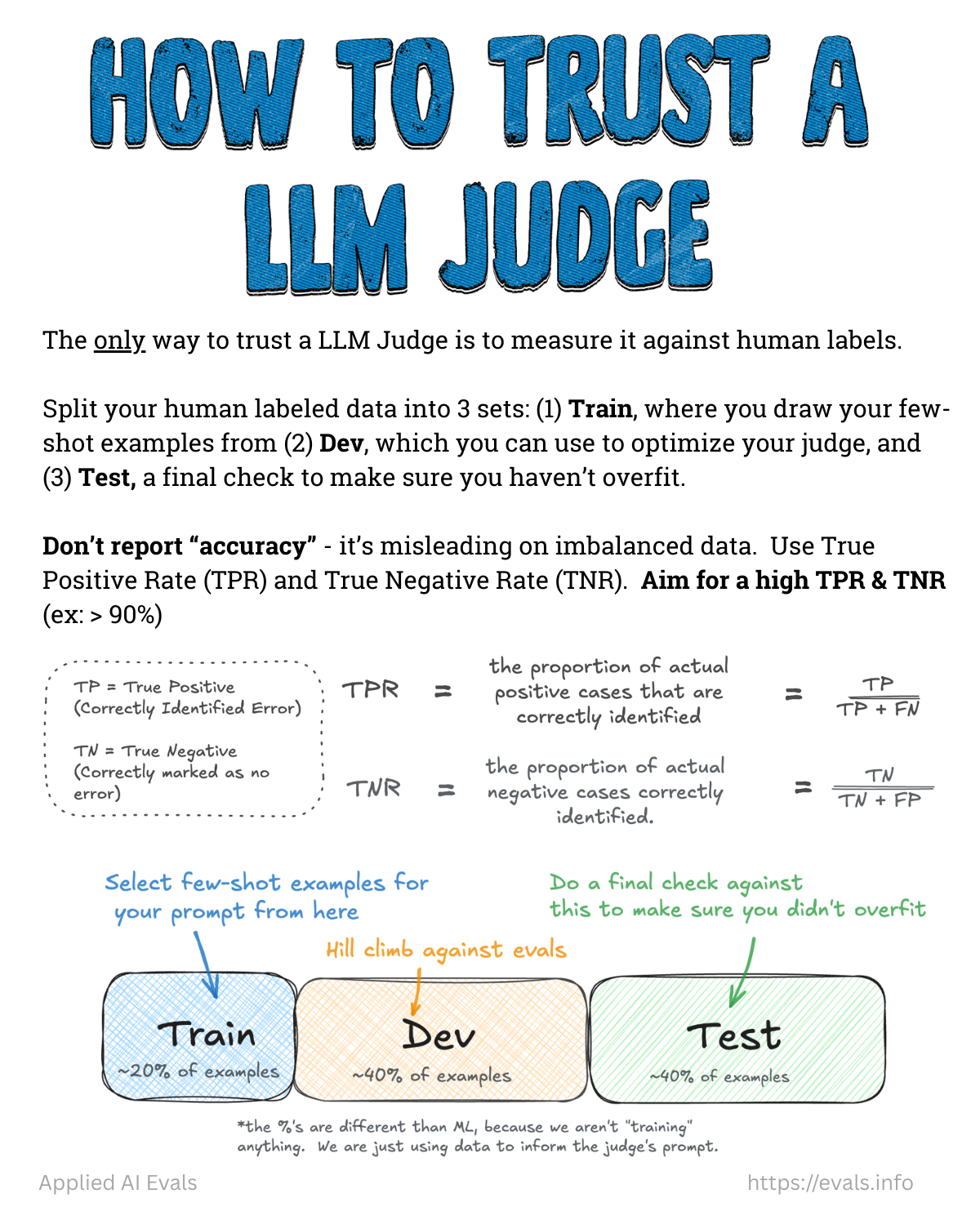
The flashcard’s dataset split is an example for prompt-based judges or zero-shot classifiers. Training a classifier may require a larger share of training data. Choose your targets based on the cost of missed failures and false alarms in your application.
This article is part of our AI Evals FAQ, a collection of common questions (and answers) about LLM evaluation. View all FAQs or return to the homepage.